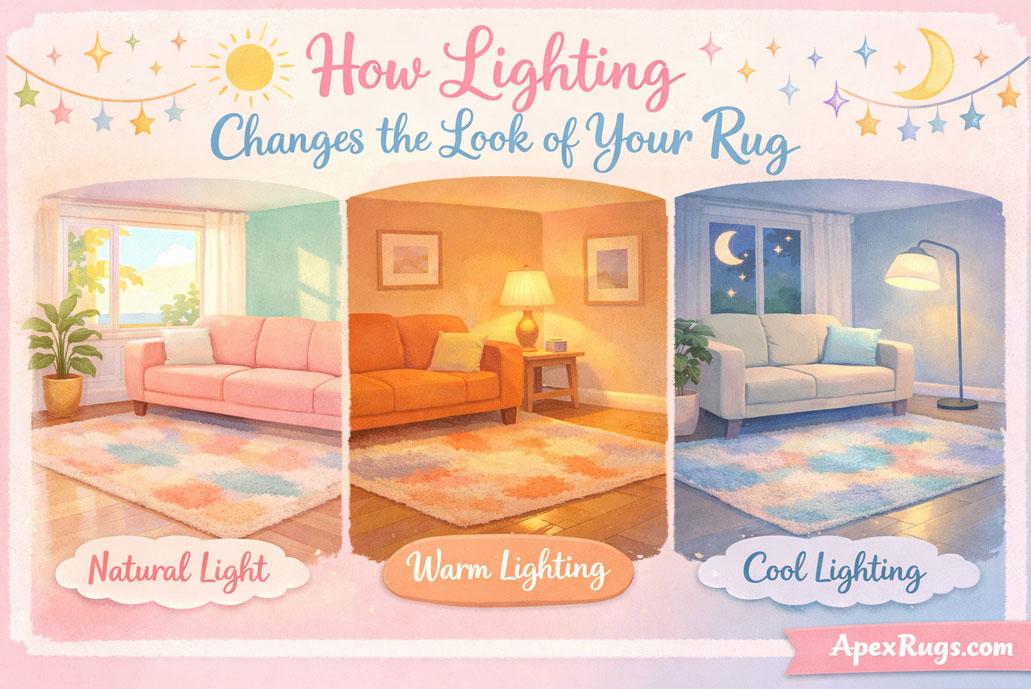
The rug you fell in love with at the showroom can look entirely different when you unroll it in your living room. That rich burgundy might appear muddy brown under your overhead fixture, or those subtle cream undertones could suddenly glow golden in the afternoon sun streaming through west-facing windows. This transformation isn't a trick of the mind or a quality issue with your purchase—it's the fundamental physics of how light interacts with textile surfaces.
Understanding the relationship between lighting and rug appearance goes beyond simple aesthetics. The right lighting can make a modest rug look luxurious, while poor lighting choices can diminish even the finest handwoven masterpiece. Whether you're selecting a new rug or troubleshooting why your recent purchase doesn't look quite right, grasping these principles will transform how you think about interior lighting design.
The Science Behind Color Perception in Textiles
Every color you perceive in a rug exists because of light wavelengths bouncing off fiber surfaces and entering your eye. When light hits a dyed wool fiber, certain wavelengths get absorbed while others reflect back. A red rug absorbs most wavelengths except red, which bounces toward your retina. But here's where lighting becomes critical: the light source itself contains varying amounts of different wavelengths, fundamentally altering which colors can reflect back to you.
Incandescent bulbs emit light heavily weighted toward the warm end of the spectrum—reds, oranges, and yellows dominate their output. When this warm light hits a blue rug, there are fewer blue wavelengths available to reflect, causing the rug to appear duller or even slightly gray-tinted. Conversely, cool LED lighting with high blue content will make that same rug appear more vibrant and true to its dyed color.
The pile height and fiber type of your rug add another layer of complexity. Wool fibers have a natural crimp and scale structure that scatters light differently than smooth silk or flat-woven cotton. High-pile rugs create countless tiny shadows between fibers, and these shadow pockets respond dramatically to the angle and intensity of light sources. A shag rug under direct overhead lighting develops deep valleys of shadow, creating a two-toned effect that completely disappears under diffused ambient lighting.
Natural Light: The Most Dramatic Variable
Windows represent the most powerful and least controllable light source in your home. The quality of natural light transforms throughout the day, shifting from cool blue morning light to warm golden afternoon rays and ending with the soft pink-orange glow of sunset. Each phase reveals different characteristics in your rug's coloring and pattern.
Morning light, particularly from east-facing windows, carries a crisp, almost blue-white quality. This cooler light temperature sharpens contrasts and makes patterns appear more defined. Rugs with intricate geometric designs or detailed floral motifs show enhanced clarity during morning hours. Cool-toned rugs—those featuring blues, greens, and purples—appear most saturated and true to their intended color during this time. Warm-toned rugs might look slightly muted or even washed out.
As the sun climbs higher, the light becomes more neutral, approaching the balanced spectrum of ideal viewing conditions. This midday light, especially from north-facing windows that receive indirect sunlight, provides the most accurate color rendering. Professional rug dealers prefer showing their inventory in north-facing rooms precisely because this light doesn't dramatically skew colors in either warm or cool directions.
Afternoon light from west-facing windows introduces intense warmth. This golden-hour illumination enriches warm colors dramatically—terracotta, rust, gold, and coral seem to glow from within. The same light can make cool colors appear muddy or shift their hue entirely. A teal rug might read as forest green, while lavender takes on a gray-brown cast. The intensity of direct afternoon sun also creates strong highlights on pile surfaces, emphasizing texture and making hand-knotted details more visible.
Seasonal variations add another dimension to natural light behavior. Winter sun sits lower in the sky, creating longer shadows and more dramatic angular lighting even at midday. Summer sun arrives from a higher angle, providing more even, diffused illumination. Your rug's appearance will shift noticeably between seasons, particularly in rooms with large windows or skylights.
Artificial Lighting Technologies and Their Effects
The type of artificial light bulb you choose creates radically different viewing conditions for your rug. Each technology has a characteristic spectral output that either complements or conflicts with rug colors.
Traditional incandescent bulbs produce warm, continuous-spectrum light that enhances reds, oranges, and yellows while suppressing blues and greens. These bulbs create a cozy, inviting atmosphere that works beautifully with traditional Persian and Turkish rugs featuring warm color palettes. The light quality feels natural and comfortable because it closely mimics firelight and candlelight, the illumination humans evolved with over millennia. However, contemporary rugs with cool gray, blue, or green schemes can appear significantly different than intended under incandescent lighting.
Halogen bulbs, technically a type of incandescent, produce a whiter, more neutral light than standard incandescent bulbs. They offer better color rendering across the spectrum while maintaining some warmth. Track lighting and accent fixtures often use halogen bulbs, and their directional nature creates strong highlights that emphasize pile texture and pattern depth.
Compact fluorescent lamps (CFLs), while becoming less common, still illuminate many homes. Early CFLs had notoriously poor color rendering, creating a harsh, flat light that made rugs appear lifeless. Modern CFLs have improved significantly, but they still produce a discontinuous spectrum with spikes in certain wavelengths. This can cause unexpected color shifts, particularly in rugs with complex dye combinations. A rug that blends red and blue fibers to create visual purple might separate into distinct red and blue elements under poor-quality fluorescent lighting.
LED technology has revolutionized home lighting and offers unprecedented control over color temperature and rendering. LEDs come in a wide range of color temperatures, from warm white (2700K) that mimics incandescent bulbs to cool white (5000K or higher) that resembles daylight. The Color Rendering Index (CRI) indicates how accurately a light source displays colors compared to natural sunlight—a CRI above 90 is considered excellent for viewing textiles and artwork.
Smart LED bulbs take this flexibility further, allowing you to adjust both color temperature and intensity throughout the day. You can program warm lighting for evening hours to enhance your rug's cozy qualities, then switch to cooler, brighter light during daytime when you want accurate color perception for decorating decisions or showing guests your textile collection.
Lighting Direction and Rug Texture
The angle from which light strikes your rug matters as much as the light's color temperature. Textile surfaces respond to directional lighting in ways that smooth surfaces like paint or laminate flooring do not.
Overhead lighting from recessed cans or flush-mount fixtures creates a fundamentally different effect than lamps positioned at floor level. When light falls straight down onto a rug, it penetrates the pile at a steep angle, reaching deep between fibers and illuminating the base while creating minimal shadowing. This lighting reveals the rug's overall color and pattern clearly but can flatten its appearance, reducing the dimensional quality that makes textiles interesting.
Side lighting from table lamps, wall sconces, or picture lights rakes across the pile surface at a shallow angle. This angular approach maximizes shadowing between individual tufts and knots, dramatically emphasizing texture. High-pile rugs develop a sculptural quality under side lighting, with every variation in pile height casting distinct shadows. The same lighting can make low-pile rugs appear almost three-dimensional as the light catches the directional pile lean created during weaving.
The pile direction itself interacts with light angle in a phenomenon called "pile shading" or "shading effect." Hand-knotted and tufted rugs have pile that leans in one direction. When you walk around the rug and view it from different angles, the color appears to shift from lighter to darker. This occurs because light reflects differently off pile lying toward you versus pile lying away from you. Lighting direction amplifies or minimizes this effect. A floor lamp positioned to light the rug with the pile grain creates a lighter, more uniform appearance, while lighting against the grain intensifies color saturation and creates richer, deeper tones.
Uplighting from floor lamps or torchières creates an entirely different effect by bouncing light off the ceiling and walls before it reaches the rug. This indirect lighting provides soft, diffused illumination that minimizes shadows and creates even color rendering across the entire rug surface. The trade-off is reduced drama and less emphasis on texture, though the overall effect feels gentle and sophisticated.
Layering Light Sources for Optimal Rug Display
Professional interior designers rarely rely on a single light source to illuminate a room. Layered lighting—combining ambient, task, and accent lighting—creates depth and flexibility that single-source lighting cannot achieve.
Ambient lighting provides overall illumination, typically from ceiling fixtures, recessed lighting, or large windows. This foundational layer ensures you can safely navigate the room and perform basic activities. For rug display, ambient lighting should be neutral in color temperature and reasonably even in distribution. Too much contrast between brightly lit and shadowed areas will make your rug appear different across its surface, breaking up the unified design.
Task lighting targets specific functional areas—reading chairs, desks, kitchen counters—with focused, often brighter illumination. When positioned near a rug, task lighting can create accidental accent effects, highlighting the portion of the rug beneath or adjacent to the task area. This can work beautifully if intentional, drawing attention to a particularly detailed section of pattern, but can appear awkward if it creates a bright spot that divides the rug visually.
Accent lighting exists purely for aesthetic purposes, highlighting artwork, architectural features, or decorative objects. Applied to rugs, accent lighting typically comes from picture lights, track lighting, or strategically placed uplights and spotlights. Gallery owners use accent lighting extensively when displaying valuable antique rugs, positioning narrow-beam spotlights to graze across the surface and maximize texture while ensuring even color rendering through careful bulb selection.
The key to successful layered lighting lies in dimmer switches and controls that let you adjust the relative contribution of each layer. Evening entertaining might call for dimmed ambient lighting, active accent lights emphasizing your rug's pattern, and bright task lighting only where needed for serving food or conversation areas. Quiet morning hours could use brighter, cooler ambient light to energize the space while keeping accent lighting off to maintain a calm atmosphere.
Color Temperature and Design Style Harmony
Different rug styles evolved in regions with distinct natural lighting conditions, and they often look most authentic when lit to approximate those original environments. Understanding these relationships helps create cohesive interior design.
Traditional Persian and Turkish rugs developed in regions with intense, warm sunlight. Their color palettes—dominated by reds, blues, and earth tones—were formulated using natural dyes that appear most vibrant under warm lighting. These rugs typically look most authentic and appealing under warm white lighting (2700K-3000K) that echoes the quality of Mediterranean and Middle Eastern sunlight. Cool lighting can make their colors appear flat and lose the depth that comes from subtle variations in hand-dyed wool.
Scandinavian and Nordic rugs emerged in environments with cooler, more diffuse natural light. Their color schemes favor grays, whites, pale blues, and muted earth tones—colors that read clearly under the cool northern light streaming through long summer days and weak winter sun. These rugs often benefit from cooler lighting temperatures (3500K-4500K) that maintain their intended crisp, clean aesthetic. Warm lighting can muddy their carefully calibrated neutral palettes.
Contemporary and modern rugs with bold graphic patterns and saturated colors require careful lighting consideration based on their specific palette. A rug using pure primary colors benefits from neutral-to-cool lighting (3500K-4000K) that maintains color separation and prevents one hue from overpowering others. Modern rugs in monochromatic gray schemes need excellent CRI lighting to reveal their subtle tonal variations—poor lighting will collapse all the grays into a single undifferentiated mass.
Natural fiber rugs in jute, sisal, seagrass, or coir show their texture more than their color. These neutral materials respond beautifully to warm lighting that enhances their golden and beige tones, creating an organic, earthy atmosphere. Cool lighting can make natural fiber rugs appear greenish or gray, losing their warmth and appearing more industrial than intended.
Problem-Solving Common Lighting Issues
Many rug disappointments stem from correctable lighting problems rather than issues with the rug itself. Identifying and addressing these situations can dramatically improve your rug's appearance.
When a rug appears washed out or faded, the issue often involves excessive lighting or light from too cool a source. Reducing overall light levels slightly and shifting toward warmer color temperatures can restore color depth. Adding a dimmer switch provides flexibility to adjust lighting intensity based on time of day and desired atmosphere.
Rugs that look muddy or unclear typically suffer from either too little lighting or lighting with poor color rendering. Increasing light levels helps, but verifying that bulbs have a CRI of at least 85 makes a bigger difference. Replacing low-CRI bulbs with high-quality LEDs instantly clarifies colors and reveals pattern details previously lost in murky illumination.
Uneven color across a rug's surface usually indicates uneven lighting distribution. Shadows from furniture, concentrated light from a single source, or strong directional natural light creates bright and dark zones that fragment the rug's visual unity. Adding additional light sources or repositioning existing fixtures to provide more even coverage solves this issue. Sheer curtains or diffusing blinds can soften harsh directional sunlight without eliminating natural light entirely.
When a rug's colors clash with the room despite careful selection, color temperature mismatch between the rug and lighting often deserves blame. Rugs chosen under cool showroom lighting appear different under warm home lighting, and vice versa. Testing rugs under various lighting conditions before purchase prevents this problem, but if you're already living with it, adjusting your home lighting to better match the conditions where you selected the rug restores the appearance you expected.
Protecting Rugs from Light Damage
Beyond affecting appearance, light exposure—particularly ultraviolet radiation from sunlight—causes permanent damage to rug fibers and dyes over time. Understanding and mitigating this damage preserves your investment while maintaining optimal display conditions.
Natural dyes, prized for their subtle beauty and environmental friendliness, show particular vulnerability to light fading. Madder reds, indigo blues, and insect-derived colors like cochineal gradually lose intensity with prolonged UV exposure. Some colors fade dramatically while others remain stable, creating unwanted color imbalances that distort the original design. Antique rugs have often survived a century or more, and further UV exposure accelerates deterioration that careful storage previously prevented.
Synthetic dyes vary widely in lightfastness. High-quality chromium dyes used in better machine-made and hand-knotted rugs resist fading reasonably well, while cheaper dyes in low-end products can show noticeable color loss within months of sun exposure. The red to pink shift is particularly common with unstable synthetic reds.
UV-filtering window films, curtains, and shades block harmful radiation while allowing visible light to pass through. These products preserve your ability to enjoy natural light without subjecting your rug to damage. UV-blocking coatings are nearly invisible and don't significantly alter the color temperature of incoming light, making them ideal for protecting valuable textiles.
Rotating rugs periodically ensures even light exposure across the entire surface. If one area receives intense afternoon sun, the unprotected zone will fade noticeably compared to sections shaded by furniture or simply receiving less light. Rotating the rug 180 degrees every six months distributes exposure more evenly, though it can't prevent fading entirely in high-UV environments.
For particularly valuable or light-sensitive antique rugs, limiting display time makes sense. Using the rug in a low-light space, storing it periodically, or installing it in rooms with minimal sun exposure extends its life dramatically. Some collectors rotate their rugs seasonally, treating them as art pieces rather than permanent floor coverings.
The Transformative Power of Intentional Lighting Design
Treating lighting as a deliberate design choice rather than an afterthought unlocks your rug's full potential. The same textile can anchor a cozy, intimate gathering space or serve as a crisp focal point in a gallery-like room, all through lighting adjustments.
Consider the transformation possible with a single antique Oushak rug in soft coral, blue, and ivory. Under warm incandescent lighting at 2700K, the coral tones intensify, creating a sunset-like glow that makes the space feel intimate and welcoming. The blues recede slightly, reading as soft gray-blue rather than pure blue, and the overall effect skews warm and enveloping. Switch to neutral LED lighting at 3500K, and the same rug appears more balanced—the blues strengthen, the corals calm, and the ivory truly reads as white rather than cream. Under cool lighting at 5000K, the rug takes on an entirely different character: the blues dominate, the corals appear almost dusty rose, and the crispness suggests a more modern, Scandinavian aesthetic despite the rug's traditional origins.
This flexibility means you're not locked into a single mood or design direction. Smart lighting systems allow programming different scenes for various occasions. Morning coffee might call for bright, cool light that energizes the space and makes your rug's colors pop with clarity. Evening relaxation could shift to warm, dimmed lighting that softens edges and creates a cozy glow. Dinner parties might feature carefully balanced layers—ambient lighting dimmed to create ambiance, accent lights highlighting your rug's pattern, and task lighting focused on the dining table.
The investment in thoughtful lighting design pays dividends beyond rug display. Quality lighting with excellent color rendering makes your entire home more beautiful, from artwork to furniture finishes to the faces of people you care about. The cost difference between basic commodity bulbs and high-CRI LEDs with good color temperature control amounts to a few dollars per bulb, yet the visual impact transforms your entire living experience.
Conclusion: Seeing Your Rug in the Best Light
The rug lying on your floor contains inherent beauty created by skilled artisans through careful selection of materials, dyes, and patterns. But that beauty remains potential until light reveals it. Like a musician needs an instrument to express their art, a rug needs appropriate lighting to display its true character.
Understanding how different light sources affect color perception, texture emphasis, and overall mood empowers you to make intentional choices. Rather than accepting whatever lighting came installed in your home or defaulting to the cheapest available bulbs, you can curate light quality as deliberately as you selected your rug.
The relationship between lighting and rugs isn't about finding one perfect solution. It's about recognizing that light is variable, controllable, and profoundly influential—then using that knowledge to create the specific atmosphere you want in each moment. Your rug can look dramatic or subtle, warm or cool, textured or smooth, all through the power of thoughtful illumination.