Getting the rug size wrong is one of those decorating mistakes that haunts a space. A too-small rug floating awkwardly in the middle of a living room, or a rug that stops just short of reaching under the furniture—these missteps can throw off the entire balance of a room, making it feel disjointed and unfinished.
The right rug does more than just add color or texture. It anchors furniture, defines zones in open-concept spaces, and creates visual cohesion. But choosing the correct size requires more than just measuring your floor space and picking the largest rug that fits. Different rooms have different requirements, and what works beautifully in a bedroom might look completely wrong in a dining room.
Understanding the Fundamentals of Rug Sizing
Before diving into room-specific guidelines, there are a few universal principles that apply across the board. The most important rule: your rug should always relate to your furniture, not just your floor. A rug that exists in isolation, with all furniture perched around its edges, creates an incomplete look that suggests the room hasn't quite come together.
The second fundamental principle involves the room's proportions. A rug should generally leave between 12 and 24 inches of bare floor between its edges and the walls. This breathing room prevents the space from feeling cramped and allows the flooring itself to frame the rug like a mat frames a painting. In smaller rooms, you might reduce this to 8 or 10 inches, but going smaller than that typically makes the rug look like it's trying to be wall-to-wall carpeting and failing.
Traffic patterns matter significantly. In high-traffic areas, the rug needs to accommodate the natural pathways people take through the room. A rug that forces people to step on and off repeatedly as they walk feels awkward and defeats the purpose of having one in the first place.
Living Room Rug Sizing: The Foundation of Gathering Spaces
The living room presents the most complex rug-sizing challenge because it typically contains the most furniture and serves multiple functions. The standard approach involves getting all of your major seating pieces at least partially onto the rug. This means the front legs of your sofas and chairs should rest on the rug while the back legs can remain on the floor.
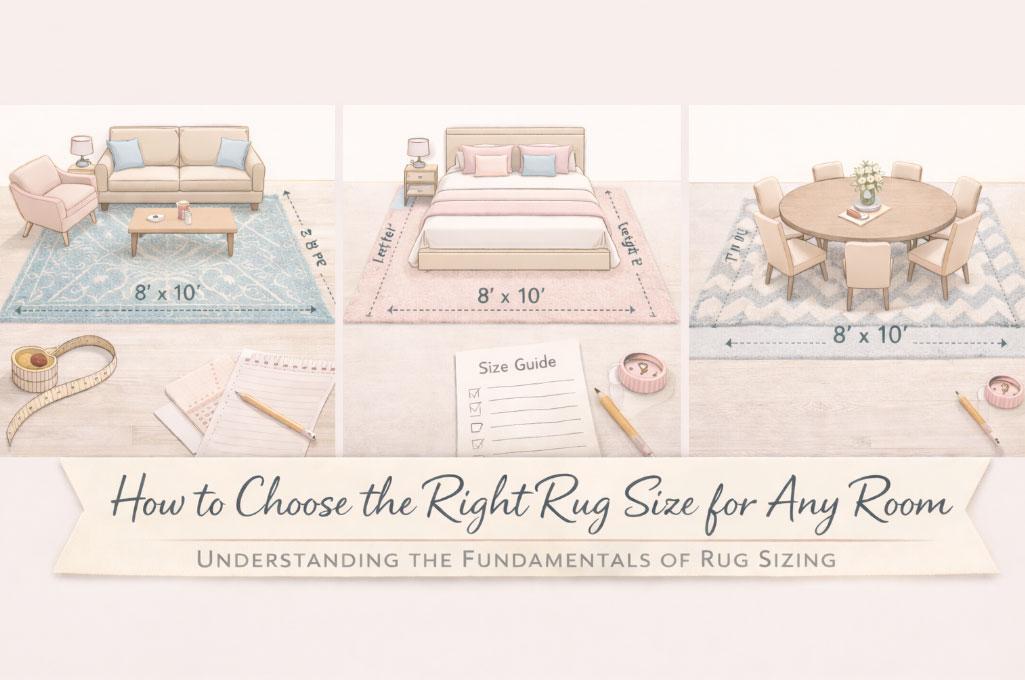
For most living rooms, this translates to an 8x10-foot rug as a minimum, though 9x12 feet is often more appropriate for average-sized spaces. Larger living rooms frequently require 10x14 or even 12x15 rugs. The specific size depends on your furniture arrangement and the room's dimensions.
When your sofa faces two chairs with a coffee table in between—the classic conversation area setup—the rug should extend at least six inches beyond the furniture on all sides. This creates a cohesive zone and ensures that when people sit down, their feet rest on the rug rather than awkwardly half-on, half-off.
The "all legs on" approach represents the gold standard for living room rugs. When you can fit all furniture legs completely onto the rug, the room achieves maximum visual unity. This typically requires a larger investment, but the impact is undeniable. The entire seating area reads as a single, intentional unit.
Sectional sofas require special consideration. Measure the full footprint of the sectional and add at least 12 inches on all exposed sides. L-shaped sectionals work beautifully with square or nearly-square rugs, while U-shaped sectionals often need rectangular rugs that extend well beyond the open end.
In open-concept spaces where the living area flows into the dining room or kitchen, the rug becomes a critical tool for spatial definition. Here, the rug should encompass only the living room furniture, stopping well before it reaches the dining table. This clear boundary helps the eye understand where one zone ends and another begins.
Dining Room Dimensions: Accounting for Chair Movement
Dining room rug sizing follows a different logic because chairs move. The non-negotiable rule: your rug must extend at least 24 inches beyond the table on all sides. This ensures that when diners pull their chairs out to sit down or stand up, the chair legs remain on the rug.
Measure your table and add 48 inches to both the length and width. This gives you the minimum rug size for that table. A 60-inch round table needs at least a 108-inch (9-foot) round rug. A 36x60-inch rectangular table requires a rug at least 84x108 inches, which roughly translates to a 7x9-foot rug, though an 8x10 provides more comfortable clearance.
Round tables pair naturally with round rugs, creating a harmonious geometric relationship. However, round rugs also work under rectangular tables if the rug is large enough. The key is ensuring adequate chair clearance on all sides.
Rectangular tables offer more flexibility. They work with rectangular, square, or round rugs. If you're choosing a rectangular rug for a rectangular table, the proportions should be similar—a long, narrow table looks best with a long, narrow rug rather than a wide one.
Many people underestimate dining room rug size, and this creates a specific kind of frustration. Chairs constantly catch on the rug's edge, making every meal feel slightly irritating. If you're between sizes, always go larger. The extra expense is worth avoiding the daily annoyance of fighting with your furniture.
In spaces where the dining table sits in a high-traffic area, consider how the rug affects movement patterns. If people need to walk past the table regularly, ensure the rug extends far enough that they're not constantly stepping on and off as they navigate around diners.
Bedroom Rug Strategies: Comfort Underfoot
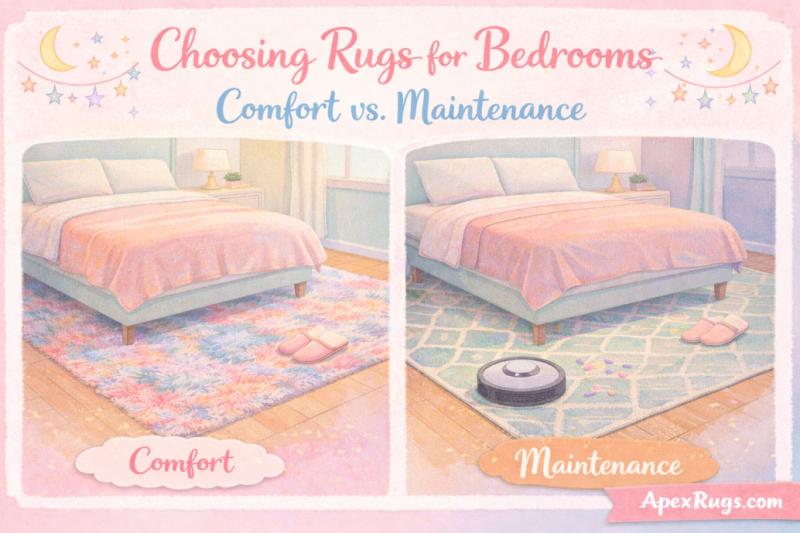
Bedrooms offer several viable approaches to rug placement, each creating a different feel. The most popular method places a large rug partially under the bed, extending out on three sides—the two sides and the foot of the bed. This rug should extend at least 18 to 24 inches beyond the sides of the bed and 24 to 36 inches beyond the foot.
For a queen bed, this typically means an 8x10 or 9x12 rug. King beds generally require a 9x12 rug at minimum, with 10x14 being more proportional in larger master bedrooms. The rug should be positioned so that when you sit on the edge of the bed, your feet land on the rug.
An alternative approach uses a smaller rug at the foot of the bed, serving as a landing pad when you get up in the morning. This works particularly well in smaller bedrooms where a large rug would overwhelm the space. A 4x6 or 5x8 rug positioned at the foot of the bed adds warmth without dominating the room.
The third option—runner rugs on both sides of the bed—works beautifully in narrow bedrooms or in spaces with beautiful hardwood floors you want to showcase. These runners typically measure 2.5 to 3 feet wide and should extend from the nightstand area down to at least the foot of the bed. This configuration provides soft landings for your feet while maintaining visual lightness.
In children's bedrooms, where play space often takes priority over traditional furniture arrangements, consider a larger rug that defines a play zone separate from the sleeping area. This might be a 6x9 or 8x10 rug positioned to create a comfortable surface for playing with toys, reading, or doing homework.
Guest bedrooms with limited space often benefit from the smaller-rug-at-the-foot approach. This provides comfort and style without requiring a major investment in a room that sees occasional use.
Kitchen and Entryway Considerations: Function Meets Form
Kitchen rugs serve a primarily functional purpose, providing cushioning in a space where people stand for extended periods. Runner rugs work exceptionally well in galley kitchens, spanning the length of the primary work zone. Standard runners come in 2.5 or 3-foot widths and various lengths, allowing you to customize the coverage to your specific kitchen layout.
In kitchens with islands, consider placing a runner along each working side of the island. These don't need to connect or match perfectly; their job is to provide comfort where you prep food and wash dishes.
Entryway rugs need to be large enough to accommodate the full swing of the door plus space for people to stand while removing shoes or setting down bags. For standard single doors, a 3x5 or 4x6 rug typically suffices. Wider entryways with double doors benefit from 5x7 or larger rugs.
The entryway rug should be positioned so that when the door opens, it doesn't push the rug into a bunched-up mess. If your door swings inward over the landing area, you may need to position the rug slightly back from the threshold or choose a rug with a non-slip backing that stays in place.
Mudrooms and transitional spaces between the garage and house need durable, easy-to-clean rugs that can handle serious dirt and moisture. These functional spaces often benefit from multiple smaller rugs—one at each entry point—rather than a single large rug.
Hallways and Runners: Creating Flow
Hallway runners should span most of the hall's length, leaving 4 to 6 inches of exposed floor at each end. The width depends on the hallway's width, but generally, you want 4 to 6 inches of bare floor on each side of the runner.
In standard 3 to 4-foot-wide hallways, a 2.5-foot-wide runner works well. Wider hallways can accommodate 3-foot runners. The runner should be long enough to feel intentional—a runner that only covers a small section of a long hallway looks incomplete and awkward.
For L-shaped or T-shaped hallways, you have options. You can use a single runner for the longest stretch and a separate smaller rug at the junction, or you can use multiple runners arranged end-to-end with small gaps between them. The gaps prevent the space from feeling overly carpeted while maintaining continuity.
Stair runners follow similar width principles. They should cover the tread from side to side with 2 to 4 inches of exposed stair showing on each side. This creates an elegant border effect while protecting the high-traffic center of each step.
Home Office and Workspace Rug Guidelines
Home office rug size depends on your furniture configuration. If you have a traditional desk setup with a desk chair, the rug needs to extend far enough that the chair can roll freely without catching on the edge. Desk chairs typically roll back 2 to 3 feet from the desk, so the rug should extend at least 3 feet beyond the desk's front edge.
For a standard 60-inch desk, a 5x8 or 6x9 rug usually provides adequate coverage. L-shaped desks require larger rugs or creative positioning—an 8x10 rug often works well, positioned to cover both legs of the desk setup.
Standing desks create different requirements. Since there's no chair to accommodate, you can use a smaller rug focused on the standing zone. An anti-fatigue mat (typically 2x3 feet) or a small area rug (3x5 or 4x6 feet) works perfectly.
In multi-use rooms where the office shares space with a guest bedroom or sitting area, use the rug to define the work zone separate from the other functions. This visual separation helps maintain mental boundaries between work and leisure time.
Layering and Creative Approaches
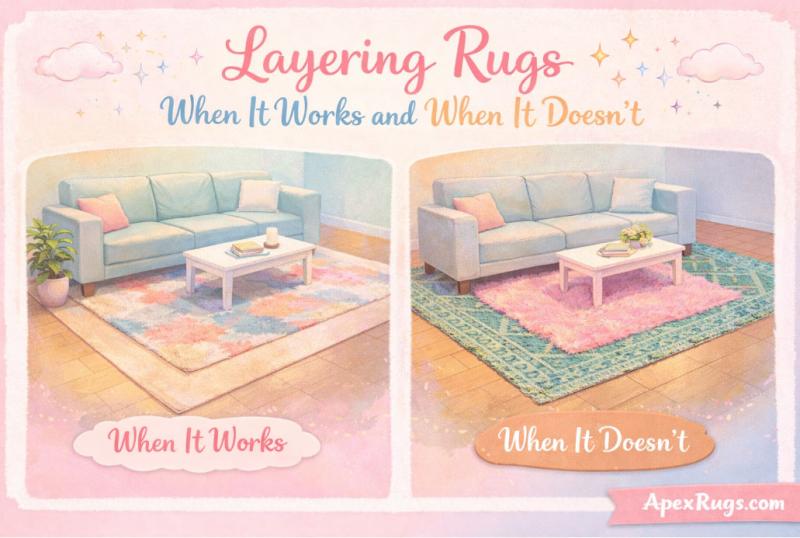
Rug layering has gained popularity as a way to add visual interest and solve sizing challenges. This technique involves placing a smaller rug on top of a larger one, creating dimension and allowing you to introduce multiple colors or patterns.
The bottom rug should be neutral and simple—sisal, jute, or a solid-color rug works well. This base layer should be sized according to the standard guidelines for your room. The top rug can be considerably smaller and more decorative, positioned to anchor a specific furniture grouping.
In living rooms, you might use a 9x12 jute rug as the base with a 5x7 patterned rug layered on top under the coffee table. This creates a focal point while ensuring all your furniture has some connection to the rug system.
Layering also solves budget constraints. Larger rugs in natural fibers like jute or sisal cost considerably less per square foot than decorative wool or silk rugs. By using an affordable large rug as your base, you can invest in a smaller, higher-quality decorative rug for the top layer.
Common Mistakes and How to Avoid Them
The floating furniture arrangement—where all furniture sits around but not on the rug—is the most common rug sizing mistake. This creates a disjointed look and makes the room feel like a furniture showroom rather than a cohesive space. Always get at least the front legs of major seating pieces onto the rug.
Buying too small is the second most frequent error. People often underestimate how much rug they need, especially in dining rooms. When in doubt, go up one size. The visual impact of a properly sized rug dramatically outweighs the additional cost.
Ignoring furniture scale leads to proportion problems. A massive sectional sofa with a tiny rug looks unbalanced. Similarly, delicate furniture pieces can be overwhelmed by an excessively large rug. The rug size should make sense in relation to your furniture's visual weight.
Placing rugs in high-traffic pathways without considering function creates daily frustrations. If people constantly trip on rug edges or the rug bunches up from foot traffic, it's either the wrong size or in the wrong location.
Measuring and Ordering: Practical Steps
Before shopping, create a scale drawing of your room and furniture. Use graph paper or an online room planner, with each square representing one foot. Draw your furniture to scale, then experiment with different rug sizes to see what works.
Alternatively, use painter's tape on your floor to mark out different rug dimensions. Live with these markers for a few days, walking through your normal routines to see how different sizes affect your movement patterns and furniture use.
When measuring, account for furniture legs and required clearances. Add those measurements to your furniture dimensions to determine the minimum rug size. Then add another 6 to 12 inches for ideal proportions.
Remember that rug sizes are approximations. A rug listed as 8x10 might actually measure 7'10" x 9'10" or 8'2" x 10'3". Check the actual dimensions before ordering, especially if you're working with tight spaces.
Final Thoughts on Rug Selection
Choosing the right rug size is as much art as science. While guidelines provide a solid foundation, your specific room, furniture, and aesthetic goals may require adjustments. Trust your eye—if something looks off, it probably is, regardless of whether it technically follows the rules.
The room's overall style should influence your approach. Modern, minimalist spaces often benefit from larger rugs with simple patterns that create calm, unified zones. Traditional or eclectic spaces can handle more complex layering and pattern mixing.
Budget constraints are real, but remember that a properly sized rug will serve you for years. A larger, neutral rug in a durable material represents a better investment than multiple smaller rugs that never quite work. Consider the rug as foundational to your room's design, worthy of the same careful consideration you'd give to a sofa or dining table.
The transformation a well-sized rug brings to a space is remarkable. It pulls disparate elements together, defines purpose, and adds comfort. By taking the time to measure carefully, consider your specific needs, and choose the right size for each room, you create spaces that feel polished, intentional, and genuinely comfortable—the hallmarks of successful interior design.